Wire, Cable & Conduit Distribution
Building wire (THHN, THWN-2, XHHW-2), service cable (SER, USE-2, UF-B), MC cable, and conduit (EMT, IMC, RMC, PVC 40/80, FMC, LFMC) from Southwire, Encore, Cerrowire, General Cable, and Priority Wire — cut-to-length or full-reel, contractor pricing.

Wire and conduit is where a contractor's margin gets made or lost. Every 1000 ft of wire and every 100 ft of conduit is a real dollar delta between authorized-channel and grey-market inventory, and every job prices differently by copper spot, aluminum spot, mill lead times, and freight class. PES Distribution stocks the working inventory of the four major building-wire mills — Southwire, Encore Wire, Cerrowire, and General Cable / Prysmian — plus Priority Wire & Cable and Nassau for the specialty lines. Conduit is Wheatland, Allied, Republic, JM Eagle, Cantex, and Carlon. Every SKU is manufacturer-verified with a mill test report on request.
All modern branch and feeder wiring in a raceway uses one of three insulation types: THHN, THWN-2, or XHHW-2. In practice, most cable is dual- or triple-rated (a jacket printed 'THHN/THWN-2' works in dry or wet conduit; a 'XHHW-2/USE-2' can be direct-buried too). Match the insulation rating to the wettest environment the wire will ever see — NEC 310.10(B/C) requires wet-location insulation anywhere raceway goes outdoors, underground, or through a concrete slab.
| Insulation type | Max temp — dry | Max temp — wet | Approved applications | Typical use |
|---|---|---|---|---|
| THHN | 90 °C | — (dry only) | Dry conduit, indoor branch/feeder | Interior EMT runs |
| THWN | 75 °C | 75 °C | Dry or wet conduit | General wet-conduit branch (older listings) |
| THWN-2 | 90 °C | 90 °C | Dry or wet conduit; nylon jacket | Modern default — replaces THHN and THWN |
| XHHW | 90 °C | 75 °C | Dry or wet conduit; crosslinked polyethylene | Feeder, service |
| XHHW-2 | 90 °C | 90 °C | Dry or wet conduit; crosslinked, no nylon | Modern feeder / service default |
| USE-2 | 90 °C | 90 °C (direct burial) | Direct burial, wet, service entrance | Underground service laterals |
| RHW-2 | 90 °C | 90 °C | Dry or wet; thicker insulation | Rare — legacy commercial spec |
⚠ The wet-location ampacity trap: THHN in a wet raceway is limited to the 75 °C column.
Marked 'THHN/THWN-2' cable is rated 90 °C in dry conduit and 90 °C in wet conduit. Marked THHN-only cable cannot be used in wet locations at all. If your conduit run passes outdoors, underground, or under a slab, spec THWN-2, XHHW-2, or USE-2 — not straight THHN. Inspectors write this up in Kentucky and Ohio routinely.
Cable assemblies bundle multiple insulated conductors under a single jacket — faster to pull than individual conductors in conduit and required by code in specific applications (residential branch wiring under NEC 334.10, health-care under 517).
| Assembly | Ampacity basis | Approved use | Typical brand + prefix |
|---|---|---|---|
| NM-B (Romex) | 60 °C column (NEC 334.80) | Dry, indoor residential branch — walls / attic / joists | Southwire, Encore, Cerro |
| SER / SEU | 75 °C column | Service entrance (SEU = weather-exposed; SER = interior sub-feed) | Southwire, Encore, Cerrowire |
| UF-B (underground feeder) | 60 °C column when direct-buried | Direct burial, wet, sunlight-resistant | Southwire, Cerrowire |
| USE-2 | 90 °C column direct-buried | Underground service lateral, wet-approved | Encore, Priority Wire |
| MC Cable (Type MC) | 75 °C column standard, 90 °C if XHHW-2 | Commercial dry/damp interior, feeder + branch | Southwire AFC/MC-Cable, AFC Cable Systems |
| MC-HL (Hazardous Location) | 75 °C column | Class I Div 2 hazardous locations | AFC MC-HL, Prysmian MC-HL |
| Armored (AC) cable | 60 °C column | Interior dry — light commercial, some AHJs require MC over AC | AFC AC-90, Southwire |
| PV Wire (PV / USE-2) | 90 °C column, 105 °C listed | PV DC circuits, exposed to sun and weather | Southwire, General Cable Suprashield |
| Tray Cable (TC-ER) | 90 °C column dry / 75 °C wet | Cable tray, exposed free-air runs | Southwire, General Cable |
When to use MC cable vs conduit-and-wire on a commercial branch circuit
- MC cable — faster to pull (single-pass), fewer boxes, works well through T-bar ceilings. Best on interior commercial branch circuits (offices, retail, tenant fit-outs) where the environment is dry and the routing is flexible. Typically 30–40 % faster labor than conduit-and-wire.
- Conduit and wire (EMT + THWN-2) — required in most hospitals, high-hazard occupancies, and any wet environment. Higher fill flexibility, easier future re-pulls, and the panel-shop can pre-pull wire into conduit runs before enclosure delivery.
- Hospital / patient-care exception — NEC 517.13(A) requires MC-HCF (health-care facility) or conduit with an equipment-grounding conductor of the type in 250.118(A) — no standard MC in patient-care areas.
Four US-domestic wire mills own the mainstream building-wire supply. All four are BABA / Buy-America compliant on their US-manufactured lines. Pricing changes daily with copper and aluminum spot; PES publishes a Monday-morning pricing sheet for the top 40 SKUs across all four mills.
| Mill | US manufacturing footprint | Strongest line | PES stock depth |
|---|---|---|---|
| Southwire | Carrollton GA (HQ), Hartselle AL, McMinnville TN, +10 US plants | SIMpull THHN, MC-Cable, Romex | Deep on all sizes 14–1000 kcmil |
| Encore Wire | McKinney TX (HQ, one massive campus) | Value-tier THHN and XHHW-2 in high volume | Deep on 14 AWG – 500 kcmil |
| Cerrowire | Hartselle AL (HQ), Ogden UT | Residential Romex + THHN in short-put-up reels | Deep on 14–10 AWG cut-lengths |
| General Cable / Prysmian | Highland Heights KY (HQ), 10 US plants | MC cable, tray cable, industrial specialty | Cut-to-length and full reels |
| Priority Wire & Cable | Little Rock AR (HQ), distribution nationwide | URD, USE-2 direct burial, industrial | Full reels for underground service |
| Nassau National Cable | Long Island NY | Specialty — PV, medium-voltage, tray cable | Special-order |
Conduit choice is a function of environment (indoor / outdoor / burial / hazardous), physical protection required (labor-space vs machine-shop vs bomb-hard), and cost. Each type has a specific NEC article that governs its use — 358 for EMT, 342 for IMC, 344 for RMC (galvanized rigid), 352 for PVC, 348 for FMC, and 356 for LFMC/LFNC.
| Type | NEC article | Wall thickness | Best for | Trade sizes stocked |
|---|---|---|---|---|
| EMT (electrical metallic tubing) | 358 | Thin-wall steel | Interior dry / damp, exposed | 1/2" – 4" |
| IMC (intermediate metal) | 342 | Medium-wall steel | Outdoor, general commercial, direct burial with fitting | 1/2" – 4" |
| RMC / GRC (galvanized rigid) | 344 | Heavy-wall steel | Outdoor, direct burial, hazardous locations, physical protection | 1/2" – 6" |
| PVC Schedule 40 | 352 | PVC, medium wall | Underground, wet, direct-burial-approved (with markings) | 1/2" – 6" |
| PVC Schedule 80 | 352 | PVC, heavy wall | Underground with physical exposure, exposed outdoor risers | 1/2" – 6" |
| FMC (flexible metal) | 348 | Interlocked steel | Interior fixture whips, motor terminations (dry) | 3/8" – 4" |
| LFMC (liquid-tight flex metal) | 350 | PVC over interlocked steel | Motor terminations, wet, oily, or vibrating | 3/8" – 4" |
| LFNC (liquid-tight non-metallic) | 356 | PVC only | Motor terminations in corrosive environments | 3/8" – 2" |
⚠ PVC Schedule 40 direct-burial marking: not all Sch 40 is DB-approved.
Only PVC conduit marked with the specific application (e.g., 'Type DB', 'Type EB', or 'Type A' for above-ground) is direct-burial listed for that use. Underground raceway typically uses Type DB120 (a specific wall-thickness class between Sch 40 and Sch 80) or Sch 40 marked 'For Above and Below Ground Use'. Check the printed jacket text before you drop conduit in a trench.
Conduit trade-size selection for a common feeder pull
- Three 4/0 THWN-2 (2/0 EGC) in a 200 A feeder — per NEC Chapter 9 Table 5 cross-section: 4/0 THWN-2 = 0.3117 in², 2/0 EGC = 0.2223 in². Three 4/0 + one 2/0 total = 1.16 in². Under NEC Table 4 (40 % fill for over 2 conductors), 2" EMT (1.34 in² max fill) is the smallest that works. Round up to 2-1/2" if pull length exceeds 100 ft with more than three 90° bends.
- Use the PES conduit fill calculator for any mixed-conductor pull — enter each conductor and insulation type, and the tool returns the smallest trade size (EMT / IMC / RMC / PVC) that stays under 40 % fill.
Confirm utility requirements for the lateral
Every utility publishes trench depth, warning tape requirements, and the wire type. LG&E wants USE-2 (or URD) at 30 in cover, red warning tape 12 in above. Duke often accepts THWN-2 in Schedule 40 PVC at 24 in cover. Match the local standard exactly.
Pick the wire — USE-2 direct-buried or THWN-2 in PVC
For 200 A: 2/0 Cu USE-2 (direct burial) or 4/0 Al USE-2 works at the 83 % rule per NEC 310.12. If pulling in conduit, spec 2/0 Cu THWN-2 or 4/0 Al XHHW-2.
Pick the conduit — PVC Sch 40 or Sch 80 for the riser
PVC Schedule 40 (DB-listed) for the horizontal underground run. Schedule 80 for the vertical riser out of grade (physical-damage protection required by NEC 300.5(D)). Common 200 A underground service uses 2-1/2" PVC — or 3" PVC if pulling 4/0 Al in with an EGC and a communications sub-duct.
Add warning tape and depth of cover
Trench 24 in (Duke, most Southeast) or 30 in (LG&E, some Northeast) minimum cover, backfill 6" of sand around the pipe, then red warning tape 12 in above the pipe, then compact backfill. Utility inspects the open trench before backfill.
Grounding electrode conductor sizing
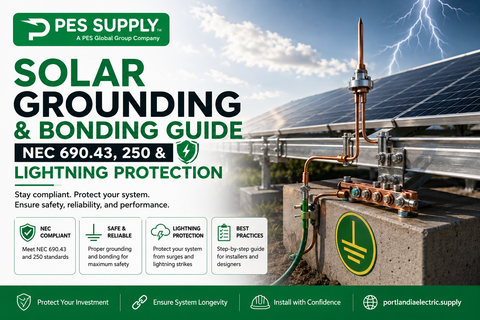
For 2/0 Cu service: #4 Cu bare GEC to two ground rods (or Ufer). For 4/0 Al: #2 Cu GEC. Table 250.66 sets the size by service-entrance conductor.
Meter socket + main disconnect at the building
See the load-center + meter-combo selector page for utility-approved sockets. Milbank U5140-XL-K3L is the LG&E standard for 200 A residential.
Can I use THHN in outdoor conduit?
Only if the printed jacket text includes THWN-2 as a dual rating. Straight THHN (no THWN-2 marking) is not permitted in wet locations, and any raceway outdoors, in a slab, or underground counts as a wet location under NEC 300.5(B) / 300.9. Modern building wire from Southwire, Encore, and Cerro is almost always dual-marked THHN/THWN-2, but always verify the print.
What's the difference between XHHW and XHHW-2?
XHHW is rated 90 °C dry, 75 °C wet. XHHW-2 is rated 90 °C dry and 90 °C wet — the extra ampacity in wet locations matters on feeders and service conductors. Modern spec is XHHW-2 for anything over #6 AWG.
Do you cut wire to length or ship full reels?
Both. Cut-to-length starts at 100 ft and is charged per-foot at your contract price plus a small cut fee. Full reels (1000 ft, 2500 ft) get the mill-reel price with no cut fee. For anything over 5000 ft, we usually direct-ship from the mill — Southwire Carrollton, Encore McKinney, or Cerro Hartselle — at contractor pricing with the mill freight passed through.
Do you carry aluminum service-entrance conductor?
Yes — 4/0 Al XHHW-2, 250 kcmil, 350 kcmil, 500 kcmil, and 750 kcmil in Southwire and Encore. Aluminum is roughly half the copper price per amp for feeders and service — most residential and light commercial service laterals in Kentucky are 4/0 Al XHHW-2 or 250 kcmil Al.
What's the difference between EMT and IMC?
EMT is thin-wall steel — cheapest, lightest, fastest to install, but not rated for direct burial and not the best for physical protection. IMC is medium-wall — heavier and stiffer than EMT, rated for outdoor and (with appropriate fitting) direct burial. RMC (rigid galvanized) is the heaviest — required for hazardous locations and any run needing serious impact protection. Cost per foot roughly EMT : IMC : RMC = 1 : 1.7 : 2.5.
Do PES stock BABA / Buy America wire and conduit?
Yes. Southwire USA-manufactured lines, Encore (all-US McKinney TX), Cerro (US Hartselle AL), Wheatland (US-melted steel conduit), Republic Conduit (US-melted steel), and JM Eagle / Cantex / Carlon PVC are all BABA-compliant. Request the certification packet at quote time for federal / DOT / utility work.
What's the ampacity of 4/0 Cu THWN-2 at 30 °C ambient in 3 CCC in 2" EMT?
From NEC Table 310.16, 4/0 Cu THWN-2 at 75 °C column = 230 A base. Three current-carrying conductors in the raceway = no derate under Table 310.15(C)(1). At 30 °C ambient, no temperature derate. Final ampacity = 230 A. Perfect for a 200 A service (using the 83 % rule per NEC 310.12, the 200 A service actually only needs 2/0 Cu THWN-2 = 175 A × 1.20 ampacity increase per 310.12).
Registered contractors — free calculators on the axis.pesdistribution.com portal
- Voltage Drop Calculator — NEC 210.19(A) informational note voltage-drop math for branch and feeder circuits, any conductor size.
- Load Balance Calculator — per-phase load balancing and neutral current on 3-phase 4-wire services.
- Conduit Fill Calculator — NEC Chapter 9 Table 1 fill percentages for EMT, RMC, PVC, and FMC in any trade size.
- Short Circuit / AIC Calculator — point-to-point available fault current at every panel and breaker AIC verification.
Register for the PES contractor portal → Free. Verified electrical contractors only.
Order wire and conduit at contractor pricing
Southwire, Encore, Cerrowire, General Cable, and Priority Wire — cut-to-length or full-reel. Wheatland, Allied, Republic, JM Eagle, Cantex, and Carlon conduit — 1/2" through 6", all trade sizes.
Register for contractor pricing