SolarEdge vs Enphase System Architecture: Optimizer+String vs Microinverter
System-level comparison of SolarEdge's HD-Wave + P-series optimizer platform against Enphase's IQ8 microinverter platform — RSD compliance, monitoring, service model, and total installed cost.

SolarEdge and Enphase together own the majority of the North American residential MLPE (module-level power electronics) market. They compete for the same job — panel-level MPPT, rapid-shutdown by design, and per-module monitoring — but they solve it with completely different system architectures. This guide is the installer-facing head-to-head: what you actually specify, install, commission, and service on each platform.
PES Supply is a direct distributor for both SolarEdge (HD-Wave, Energy Hub, SE33.3K, SE100K, P-series optimizers, S-series safety devices) and Enphase (IQ8+ / IQ8H / IQ8P / IQ8P-3P microinverters, IQ Combiner 5C, IQ System Controller, IQ Battery 5P/10T). Both ship from our Louisville, KY warehouse with full manufacturer warranty and RMA support.
The one-line summary: SolarEdge is one central inverter + one DC optimizer per panel; Enphase is one AC microinverter per panel, no central inverter, no high-voltage DC. That architectural fork changes almost every downstream decision.
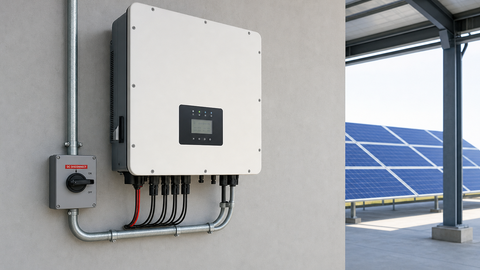
The diagram at the top shows the two topologies. Below is the same picture in words, mapped to what you actually put on the truck.
| Component | SolarEdge (optimizer + string) | Enphase (microinverter) |
|---|---|---|
| MLPE per module | P340 / P400 / P505 / P801 DC optimizer | IQ8+ / IQ8H / IQ8P (AC microinverter) |
| Wire type from roof | Series-string 350–500 Vdc high-voltage DC | AC trunk (Q Cable) at 240 V single-phase or 208 V 3-phase |
| Central inverter | HD-Wave SE7600H-US / SE10000H-US / SE11400H-US | None on residential (grid-forming built into microinverter) |
| Combiner / gateway | N/A — string lands on inverter directly | IQ Combiner 5C (contains Envoy gateway + PV breakers) |
| Battery integration | Energy Hub inverter + Energy Bank (LG Chem RESU-16H Prime) | IQ Battery 5P / IQ10T + IQ System Controller |
| RSD compliance | SafeDC (each optimizer stops output when initiator dies) | Native — no DC to shut down (every panel is AC) |
| Monitoring platform | mySolarEdge (installer + homeowner apps) | Enlighten Manager + Enphase App |
Both platforms give you per-module data (production per panel, per-panel fault detection) and both comply with NEC 690.12 rapid shutdown — but they do it via completely different mechanisms.
| Attribute | IQ8+ / IQ8H / IQ8P / IQ8P-3P | HD-Wave SE3800H / SE7600H / SE10000H / SE11400H |
|---|---|---|
| Rated AC output | 295 / 320 / 384 / 480 W per unit | 3.8 / 7.6 / 10.0 / 11.4 kW per inverter |
| Peak efficiency | 97.5% (IQ8P) | 99.0% (HD-Wave, industry-leading) |
| Weighted CEC η | 97.0% | 99.0% |
| MPPT count | 1 per panel (equal to panel count) | 1 or 2 per inverter |
| DC input voltage | 16 – 58 Vdc (per panel) | 300 – 480 Vdc (nominal 400 V) |
| Grid-forming (sunlight backup) | Yes — IQ8+ family without a battery | No — needs Energy Hub + Energy Bank for backup |
| Enclosure | Sealed potted enclosure, NEMA 6 | Aluminum, NEMA 4X, wall-mount |
| Weight | ~2.7 lb each | SE7600H: 46 lb |
| Warranty (residential) | 25 yr | 12 yr standard, 25 yr extended |
The 99% HD-Wave efficiency is real — SolarEdge's second-generation HD-Wave topology skips the traditional isolation transformer and pushes efficiency past what a conventional string inverter can hit. The IQ8's grid-forming capability is also real: an IQ8+ system can produce PV during a grid outage even without a battery, up to the daylight-power available (called Sunlight Backup with the IQ System Controller). Neither of those single-line wins ends the debate — you're picking a platform, not a spec sheet.
NEC 690.12 requires PV rapid shutdown so first responders can safely operate on a roof. The 2020 code distinguishes string-level RSD (any conductor entering a building bounded to under 30 Vdc within 30 seconds) from module-level RSD (any conductor within a 1-foot boundary of the array under 80 V within 30 seconds and under 30 V within 30 sec more).
| Requirement | SolarEdge (P-series optimizer) | Enphase (IQ8 microinverter) |
|---|---|---|
| Module-level RSD by design | Yes — each P-optimizer stops output when the initiator signal is lost | Yes — no DC exists to shut down; each module runs at 240 V AC only when grid is present |
| External initiator needed | No — the HD-Wave inverter acts as the initiator | No — the microinverter itself detects grid loss |
| Time to safe voltage | 30 seconds to <30 V/optimizer | ≈100 ms to zero AC |
| Failure mode | Optimizer fails safe (open circuit) | Microinverter fails safe (AC disconnect) |
| Third-party RSD device | N/A | N/A |
Both platforms clear NEC 690.12-2020 without an add-on transmitter. String inverters from other brands (Fronius, SMA, Solis, EG4, Sol-Ark, Chint) typically require pairing with a Tigo TS4-A-F or APsmart RSD-S/D device to hit module-level RSD; SolarEdge and Enphase have RSD built in as an architectural property.
Both companies operate first-party monitoring platforms with tiered access (installer / dealer / homeowner). The differences are subtle but matter over years of fleet ownership.
| Monitoring feature | SolarEdge mySolarEdge + Monitoring Portal | Enphase Enlighten Manager + App |
|---|---|---|
| Per-module production | Yes | Yes |
| Per-module fault alerting | Yes (alert queue in installer app) | Yes (alert per-serial, geolocated on layout) |
| Homeowner app | mySolarEdge (energy + battery + EV) | Enphase App (energy, battery, EV, storm-guard) |
| Fleet dashboard | SolarEdge Monitoring Portal (all sites) | Enlighten Manager (all sites) |
| API access | Yes (public REST API) | Yes (public REST API, tighter rate limits) |
| Third-party integration | Home Assistant, HomeAssistant, Solar Assistant | Home Assistant, Solar Analytics, Enphase App SDK |
| Cellular gateway option | Yes (SetApp Mobile) | Yes (IQ Gateway Metered Cellular) |
SolarEdge's advantage: a single portal shows every install you've ever done under one login, and the installer-side alerting queue is well-tuned for a service organization triaging tickets. Enphase's advantage: the homeowner-facing app has consumer polish that outsells the SolarEdge equivalent in premium residential markets — for installers pitching to educated homeowners, this matters.
| Failure scenario | SolarEdge | Enphase |
|---|---|---|
| Optimizer / microinverter fails on one panel | Truck roll to swap optimizer under panel (30–60 min) | Truck roll to swap microinverter under panel (30–60 min) |
| Central inverter fails | Truck roll to swap HD-Wave inverter (2–3 hours, homeowner offline meanwhile) | N/A — no central inverter |
| RMA path (parts) | SolarEdge USA — 2-day advance ship | Enphase USA — pre-paid FedEx both ways, 3–5 days |
| Labor allowance | Case-by-case (through the extended warranty) | None — labor is installer responsibility, but pre-paid shipping reduces cost |
| Firmware updates | Automatic over cellular or Wi-Fi | Automatic over IQ Gateway |
Both platforms have solid service infrastructure. Enphase's architectural advantage is that a microinverter failure only takes one panel offline — the rest of the system keeps producing. A SolarEdge inverter failure takes the whole system offline until the swap happens, but the failure rate is meaningfully lower (fewer moving parts per system).
A representative 8 kW residential grid-tie system with 20 × 400 W panels. Contractor pricing approximate — real quote from the PES contractor portal.
| Line item | SolarEdge system | Enphase system |
|---|---|---|
| Central inverter | SE7600H-US ≈ $1,795 | — (none) |
| MLPE (20 modules) | 20 × P505 ≈ $1,300 ($65 each) | 20 × IQ8+ ≈ $2,900 ($145 each) |
| Combiner + gateway | — (integrated in inverter) | IQ Combiner 5C ≈ $625 |
| System controller / RSD | SetApp / built-in ≈ $0 | — (native) |
| Q Cable / whips | — (DC string wire is cheaper) | Q Cable + terminators ≈ $220 |
| Total inverter-side BOM | ≈ $3,095 | ≈ $3,745 |
| Efficiency (weighted) | 99.0% × strings | 97.0% × per-panel |
Enphase runs roughly $650 higher on inverter-side BOM at the 8 kW scale, offset by (a) simpler DC-side balance-of-system (no combiner, no rapid-shutdown transmitter, no series-string voltage math) and (b) higher labor productivity in shaded / multi-orientation designs where SolarEdge would need multiple strings and hence multiple inverters.
Enphase wins: complex roofs, multiple orientations, heavy shading.
A hip roof with three or four planes, or heavy afternoon shade from a chimney, kills string design. Enphase's per-module MPPT means one bad panel doesn't take out the rest of the string — you get 95%+ of nameplate on the unshaded modules. SolarEdge P-optimizers help here too but the architecture cap is that all modules on one string share Vmp — mixing orientations still means running multiple strings, hence multiple inverters at some point.
SolarEdge wins: single-plane roofs where inverter efficiency + monitoring drives ROI.
A clean south-facing single-plane roof plays to SolarEdge's strengths — 99% HD-Wave efficiency, one inverter to install, one point of failure (which fails rarely). Enphase's per-panel AC-conversion overhead becomes a slight efficiency cost at this configuration.
Enphase wins: sunlight backup without a battery (IQ8+ family).
The IQ8+ family can grid-form and produce PV during an outage without a battery, up to the daylight-power available. SolarEdge requires the Energy Hub inverter + Energy Bank battery to do the same.
SolarEdge wins: whole-home backup at the 10 kW+ level with a lithium battery.
The SolarEdge Energy Hub inverter + Energy Bank battery + backup interface delivers 10 kW+ continuous backup with a battery cabinet designed for the load. Enphase's IQ Battery 5P is 3.84 kW continuous per unit — you'd stack 3 to match, which drives cost.
Enphase wins: consumer polish, installer pitching to educated homeowners.
The Enphase brand carries a premium in residential markets and the homeowner app is measurably better than the SolarEdge equivalent. If you're pitching an $80k+ solar+storage system to a discerning homeowner, Enphase closes more of those deals.
SolarEdge wins: installer service organization managing 500+ sites under one portal.
The SolarEdge Monitoring Portal's fleet-level alerting workflow is more mature. Enphase Enlighten Manager is competitive but SolarEdge's installer tier has a slight edge on service-org tooling.
Registered contractors — free calculators on the PES portal
- String Sizing Calculator — Voc/Vmp string voltage vs inverter Vdc-max, temperature-corrected per NEC 690.7.
- Compatibility Checker — live inverter + battery + panel compatibility against manufacturer-approved lists.
- Solar System Calculator — end-to-end kW-DC / kW-AC / battery sizing for a target daily kWh load.
- ROI Calculator — payback and IRR against your local rate schedule and financing.
- Voltage Drop Calculator · Load Balance Calculator
Register for the contractor portal → Free. Verified installers only.
Which is more efficient overall — SolarEdge or Enphase?
At the module-to-AC output level, SolarEdge HD-Wave inverters hit 99.0% weighted CEC efficiency while Enphase IQ8 microinverters hit ~97.0%. The gap is 1.5–2 percentage points at the conversion stage. In shaded or multi-orientation designs, Enphase recovers most of that gap at the system level because per-panel MPPT doesn't pay a mismatch penalty. On a clean single-plane roof, SolarEdge produces slightly more per kW-DC installed.
Do I need external rapid-shutdown hardware with either brand?
No. Both SolarEdge (with P-series optimizers on each module) and Enphase (native, since AC is only present when the grid or IQ System Controller is powered) meet NEC 690.12-2020 module-level RSD without any add-on transmitter. Any string inverter brand (Fronius, SMA, Solis, EG4, Sol-Ark, Chint) requires pairing with a Tigo TS4-A-F or APsmart RSD device to reach module-level RSD.
Can IQ8 microinverters produce power during a grid outage?
Yes — the IQ8+, IQ8M, IQ8H, and IQ8P are grid-forming, meaning they can run in an off-grid mode without a battery. You install an IQ System Controller (with the microgrid interconnect device) to sever from the grid, and the microinverters produce AC up to the daylight-power available (Sunlight Backup). Continuous whole-home backup still requires an IQ Battery for load leveling.
Does SolarEdge require an optimizer on every panel?
For the standard HD-Wave residential platform, yes — every module must have a P-series optimizer to meet module-level RSD. On the SolarEdge commercial platform (SE33.3K, SE100K) you have the option of pairing with SafeDC modules or using SolarEdge's TerraMax platform which decouples optimizers from inverters. For residential, plan on one P-optimizer per module.
How much does an Enphase system cost vs SolarEdge for an 8 kW install?
Approximate contractor-tier BOM at 8 kW: SolarEdge ≈ $3,095 (SE7600H + 20 × P505), Enphase ≈ $3,745 (IQ Combiner 5C + 20 × IQ8+). Enphase is ~$650 higher inverter-side, offset by simpler DC balance-of-system and potentially higher labor productivity on complex roofs. Precise real-time quotes are inside the PES contractor portal.
What's the warranty on each platform?
Enphase IQ8 microinverters: 25 years standard (residential). SolarEdge HD-Wave inverters: 12 years standard, extendable to 25 years. P-series optimizers: 25 years standard. Both are best-in-class among the brands PES distributes.
Can I mix SolarEdge and Enphase on the same site?
Yes — the two systems are electrically independent at the AC interconnect. Some installers deploy Enphase on shaded roofs and SolarEdge on a clean detached ground-mount at the same address, sharing the utility interconnection. Both platforms have separate monitoring so the homeowner sees two dashboards, but revenue-grade production monitoring aggregates cleanly at the utility meter.
Ready to spec a SolarEdge or Enphase system?
Direct-distributor pricing on EG4, SolarEdge, Enphase, Sol-Ark, Fronius, SMA, Solis, GoodWe, APsystems, Chint, Sungrow, OutBack, MidNite, Schneider, and Growatt inverters. Louisville-warehoused, pallet-freight quoted at checkout.
Register for contractor pricing