Solar Inverter Sizing Reference Guide: DC/AC Ratio, String Voltage, and Configuration Tables
Reference guide for sizing string inverters: DC/AC ratio math, temperature-corrected string voltage against Vdc-max, hybrid vs grid-tie load sizing, and a table of common configurations with suggested SKUs from the PES catalog.

This is a reference guide, not an interactive calculator. Sizing an inverter well depends on three numbers you can compute in your head: DC/AC ratio, temperature-corrected string voltage against inverter Vdc-max, and DC-side breaker sizing. This article walks the math and gives you a lookup table of common configurations.
DC/AC ratio = array kW-DC ÷ inverter kW-AC. An 8 kW-DC array on a 6.6 kW-AC inverter is a 1.21 DC/AC ratio. This is the single most important sizing decision — it trades installed cost against production loss (clipping) and it drives inverter selection.
| DC/AC ratio | What it means | Annual clipping loss | When to spec |
|---|---|---|---|
| < 1.10 | Undersized array | 0% (there's nothing to clip) | Rare — you're throwing money at inverter capacity you'll never use |
| 1.10 – 1.15 | Conservative — full inverter utilization only near solar noon | ≤ 0.2% | AHJ constrained by array area but customer wants headroom |
| 1.15 – 1.30 | Recommended for residential grid-tie + hybrid | ≤ 1.5% | Standard residential; most C&I 208 V (Chint SCA, Fronius Symo, EG4 12000XP) |
| 1.30 – 1.45 | Aggressive — trades ~2–4% annual production for lower $/kW-AC | 2.0 – 4.0% | Utility-scale ground-mount; large commercial rooftops |
| > 1.45 | Excessive clipping — array is oversized | 5%+ per year | Uncommon — usually a design error or an inverter downgrade |
The chart at the top of this page visualizes annual clipping loss vs DC/AC ratio for a typical mid-latitude US site. Two rules of thumb:
- Residential + light-commercial: design at 1.20 DC/AC. That's the industry sweet spot for full inverter utilization at reasonable clipping loss.
- Utility ground-mount: design at 1.35 DC/AC. The economics favor lower $/kW-AC over the ~2% clipping penalty.
PV modules produce their highest Voc at the site record low temperature, not at STC (25°C). Ignore this and you'll pop a string over Vdc-max on the coldest morning of the year. The NEC formula (NEC 690.7):
NEC 690.7 temperature-corrected string voltage
- Voc,corrected = Voc,STC × [1 + β × (Tmin − 25°C)]
- β = module temperature coefficient of Voc (negative — Voc goes up as temp goes down). Typical crystalline silicon: β ≈ -0.28%/°C.
- Tmin = site record low extreme minimum ambient temperature (from ASHRAE 2% design temp or NREL data).
Then: string Voc,corrected × number of modules per string ≤ inverter Vdc,max.
Common inverter Vdc-max values across the PES catalog:
| Inverter | Vdc-max | Typical Voc-STC panel | Max modules per string (25°C) | Max at −20°C site |
|---|---|---|---|---|
| EG4 6000XP | 500 V | 45 V (400 W panel) | 11 modules | 10 modules |
| EG4 12000XP | 600 V | 45 V | 13 modules | 12 modules |
| EG4 18kPV | 600 V | 45 V | 13 modules | 12 modules |
| Sol-Ark 12K / 15K | 500 V | 45 V | 11 modules | 10 modules |
| SolarEdge HD-Wave (all) | 480 V | N/A (optimizer feed) | ~26 optimizers @ 60 V | N/A |
| Chint SCA25KTL | 1000 V | 45 V | 22 modules | 20 modules |
| SMA Tripower CORE1 50 | 1000 V | 45 V | 22 modules | 20 modules |
| Fronius Symo 24.0-3 | 1000 V | 45 V | 22 modules | 20 modules |
| Solis 60K-5G-C&I | 1100 V | 45 V | 24 modules | 22 modules |
The "-20°C site" column applies to most of the northern US and Canada. Southern US sites can push a module or two more per string; extreme-cold sites (upper Midwest, Alaska) drop back a module or two below the -20°C column. The String Sizing Calculator in the PES contractor portal does this math against your specific site record-low temperature and module datasheet.
Voc-max sets the ceiling; MPPT-min sets the floor. The inverter needs to see enough string voltage at high temperature to stay in its MPPT operating range — otherwise it drops out of tracking and production goes to zero.
- Vmp at high temp: Vmp,STC × [1 + β × (Thot - 25°C)]. A hot-cell temperature of 65°C on a summer roof is typical.
- String Vmp,corrected ≥ inverter MPPT-min.
For an inverter with MPPT-min = 120 V and a module with Vmp-STC = 38 V and β = -0.35%/°C at Vmp: Vmp at 65°C ≈ 38 × (1 - 0.35% × 40°C) ≈ 32.7 V. Minimum string size ≈ 120 / 32.7 ≈ 4 modules. Most residential + commercial designs run 8–20 modules per string, so MPPT-min is rarely the binding constraint — but it will bite on 2-module short strings in a tight parapet-wall install.
| Array size (kW-DC) | Panels (400 W) | String config | DC/AC target | Inverter shortlist |
|---|---|---|---|---|
| 4.8 kW | 12 panels | 1 × 12 | 1.20 | EG4 6000XP · Sol-Ark 5K-1P · SolarEdge SE3800H |
| 6.4 kW | 16 panels | 2 × 8 | 1.20 | EG4 6000XP · Sol-Ark 5K-1P · SolarEdge SE5000H |
| 8.0 kW | 20 panels | 2 × 10 | 1.20 | EG4 6000XP · Sol-Ark 8K · SolarEdge SE7600H · Enphase IQ8+ × 20 |
| 10.0 kW | 25 panels | 3 × 8 + 1 × 1 | 1.20 | EG4 12000XP · Sol-Ark 8K · SolarEdge SE10000H · Enphase IQ8H × 25 |
| 12.0 kW | 30 panels | 3 × 10 | 1.20 | EG4 12000XP · Sol-Ark 12K-2P · SolarEdge SE11400H |
| 16.0 kW | 40 panels | 4 × 10 | 1.33 | EG4 12000XP · EG4 18kPV · Sol-Ark 15K · SolarEdge SE11400H |
| 18.0 kW | 45 panels | 3 × 15 | 1.29 | EG4 18kPV · EG4 FlexBOSS21 · Sol-Ark 15K |
| 21.0 kW | 52 panels | 4 × 13 | 1.31 | EG4 FlexBOSS21 · 2 × Sol-Ark 12K-2P |
| 25 kW C&I | 62 panels | 3 × 20 + 1 × 2 | 1.30 | Chint SCA25KTL · Fronius Symo 24.0-3 · SolarEdge SE33.3K |
| 50 kW C&I | 125 panels | 6 × 20 + 1 × 5 | 1.31 | 2 × Chint SCA25KTL · SMA Tripower CORE1 50 |
| 100 kW C&I | 250 panels | 10 × 20 + 5 × 10 | 1.33 | SMA Tripower CORE1 × 2 · SolarEdge SE100K · Solis 60K × 2 |
The suggested inverter shortlist is deliberate: multiple brands per config so you can pick against the customer's constraints (backup requirement, roof complexity, brand preference, budget). Live inventory and contractor pricing are inside the PES contractor portal — the Compatibility Checker validates the inverter + battery + panel combination against manufacturer-approved lists in real time.
Sizing a hybrid inverter is not the same as sizing a grid-tie inverter. You add two constraints:
Backup load (kW peak, not average).
Inventory the backup circuits and total their peak load. Include LRA (locked-rotor amps) for compressors and pumps. A 4-ton heat pump with ~72 A LRA at 240 V is 17 kVA for a few cycles — the inverter surge rating must clear this.
Battery bank capacity (kWh) sized to autonomy target.
Autonomy in hours × average backup load = required kWh. For 12 hours of backup at 3 kW average = 36 kWh — three EG4 PowerPro 14.3 kWh batteries or four Sol-Ark-approved Fortress eVault 12 kWh. Round up 15–20% for depth-of-discharge margin.
Charge / discharge current at 48 V nominal.
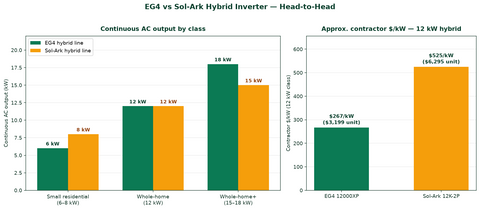
Inverter's DC current rating (typically 185 – 300 A cont. on 48 V units) must exceed peak charge or discharge amps. On the EG4 12000XP that's 250 A continuous — good for ~12 kW discharge. Sol-Ark 12K-2P is 275 A / ~13 kW.
PV DC/AC ratio on hybrid platforms.
Hybrid inverters advertise 'PV input kW' that's often higher than 'AC output kW' — the EG4 12000XP takes 24 kW PV into a 12 kW AC output, so that's a 2.0 PV/AC ratio designed for surplus into batteries. Model the DC/AC ratio against the AC output when calculating grid-export clipping, and use the higher PV input for battery-charging headroom.
Long DC string runs from a rooftop to a ground-level inverter cabinet lose power to conductor resistance. NEC 690.8 requires the DC voltage drop across the array-to-inverter conductors to be ≤ 3% at nameplate, and best practice is ≤ 2% to preserve MPPT tracking margin.
Vdrop = 2 × L × I × RΩ/1000ft / 1000 (round-trip drop across the DC pair).
For a 400 V string carrying 12 A over 150 ft of #10 AWG copper (R = 1.24 Ω/1000 ft): Vdrop = 2 × 150 × 12 × 1.24 / 1000 = 4.46 V ≈ 1.1% drop. Fine. Same string on 250 ft of #10 AWG: 1.9%. Push to 400 ft: 3.0%. At that point step up to #8 AWG.
Use the Voltage Drop Calculator on the PES contractor portal to solve for gauge, distance, or drop against real-world temperature and conduit fill.
Registered contractors — free calculators on the PES portal
- String Sizing Calculator — Voc/Vmp string voltage vs inverter Vdc-max, temperature-corrected per NEC 690.7.
- Compatibility Checker — live inverter + battery + panel compatibility against manufacturer-approved lists.
- Solar System Calculator — end-to-end kW-DC / kW-AC / battery sizing for a target daily kWh load.
- ROI Calculator — payback and IRR against your local rate schedule and financing.
- Voltage Drop Calculator · Load Balance Calculator
Register for the contractor portal → Free. Verified installers only.
What DC/AC ratio should I design for a residential grid-tie system?
1.15 – 1.30 is the recommended DC/AC range for residential grid-tie and hybrid systems. 1.20 is the industry sweet spot — full inverter utilization near solar noon with less than 0.5% annual clipping loss. Above 1.30 you're trading production for lower $/kW-AC; below 1.15 you have inverter capacity that's rarely used.
How do I check my string voltage against inverter Vdc-max?
Apply NEC 690.7: V_oc,corrected = V_oc,STC × [1 + β × (T_min − 25°C)] where β is the module temp coefficient of Voc (negative, ~-0.28%/°C for c-Si) and T_min is your site record extreme minimum ambient. Multiply the corrected Voc by modules-per-string and compare to inverter Vdc-max. The PES portal String Sizing Calculator does this against your ZIP-code-specific low temperature.
Do the DC/AC ratios differ for utility ground-mount?
Yes — utility-scale designs typically run 1.30 – 1.40 DC/AC. Marginal $/kW-DC drops faster than clipping loss grows at that scale, so aggressive DC oversizing pays back. Residential rarely benefits from > 1.30.
What's the difference between the sizing math for a hybrid vs grid-tie inverter?
Grid-tie sizing is about DC/AC ratio and string voltage. Hybrid sizing adds three constraints: peak backup load (kW including LRA surge), battery bank capacity (kWh for autonomy target), and inverter DC current rating at 48 V (charge/discharge amps). Hybrid platforms often accept higher PV input than AC output — the EG4 12000XP takes 24 kW PV into 12 kW AC because the excess goes to battery charging.
What conductor size for a 400 ft DC run from roof to inverter?
At 12 A DC and 400 V string voltage, 400 ft round-trip on #10 AWG copper = ~3% drop; use #8 AWG to stay under 2%. Longer runs may need #6 AWG. The Voltage Drop Calculator in the PES portal solves for gauge given target drop percentage.
Does the PES contractor portal do this sizing math live?
Yes. Registered contractors get free access to: String Sizing Calculator (site-specific temperature vs Vdc-max), Compatibility Checker (inverter + battery + panel against live manufacturer AVLs), Solar System Calculator (end-to-end kW-DC / kW-AC / battery sizing for target daily kWh), Voltage Drop Calculator, Load Balance Calculator, and ROI Calculator. Register free →
Where can I find suggested SKUs for my specific configuration?
The configuration table above lists shortlist inverter models per array size. For a live SKU pull with real-time inventory and contractor pricing, use the PES contractor portal. New accounts are typically verified inside 4 business hours.
Register free for the interactive PES contractor sizing tools
Direct-distributor pricing on EG4, SolarEdge, Enphase, Sol-Ark, Fronius, SMA, Solis, GoodWe, APsystems, Chint, Sungrow, OutBack, MidNite, Schneider, and Growatt inverters. Louisville-warehoused, pallet-freight quoted at checkout.
Register for contractor pricing